
Singing together across 8,000 miles.
Alex and Gabbi are in Los Angeles. Cody is in Canberra. Will is in Melbourne. They talked, worked out what they were going to do, sang Amazing Grace, and then listened back and told each other what they thought. Stay for that part. It’s at the end.
Between takes this behaves like any video call, because that’s what a rehearsal mostly is. The synchronized part is the few minutes in the middle.
Alex Siegers (director, alto), Los Angeles · Gabbi Coenen (soprano), Los Angeles · Cody Christopher (tenor), Canberra · Will Darbyshire (bass), Melbourne. Two takes. No editing, no post-production alignment.
Why this is hard
You already know Zoom can’t do this. What you may not know is why, because it isn’t a bandwidth problem and you can’t buy your way out of it.
Sound takes time to travel. Signals take time to cross a network. On a video call, every singer hears every other singer a little late, and each one is late by a different amount that changes minute to minute. Ask twenty people to sing together under those conditions and you don’t get a choir. You get twenty people politely dragging each other backwards.
How it works
Everyone syncs to the same thing
We don’t fight the latency. We step around it.
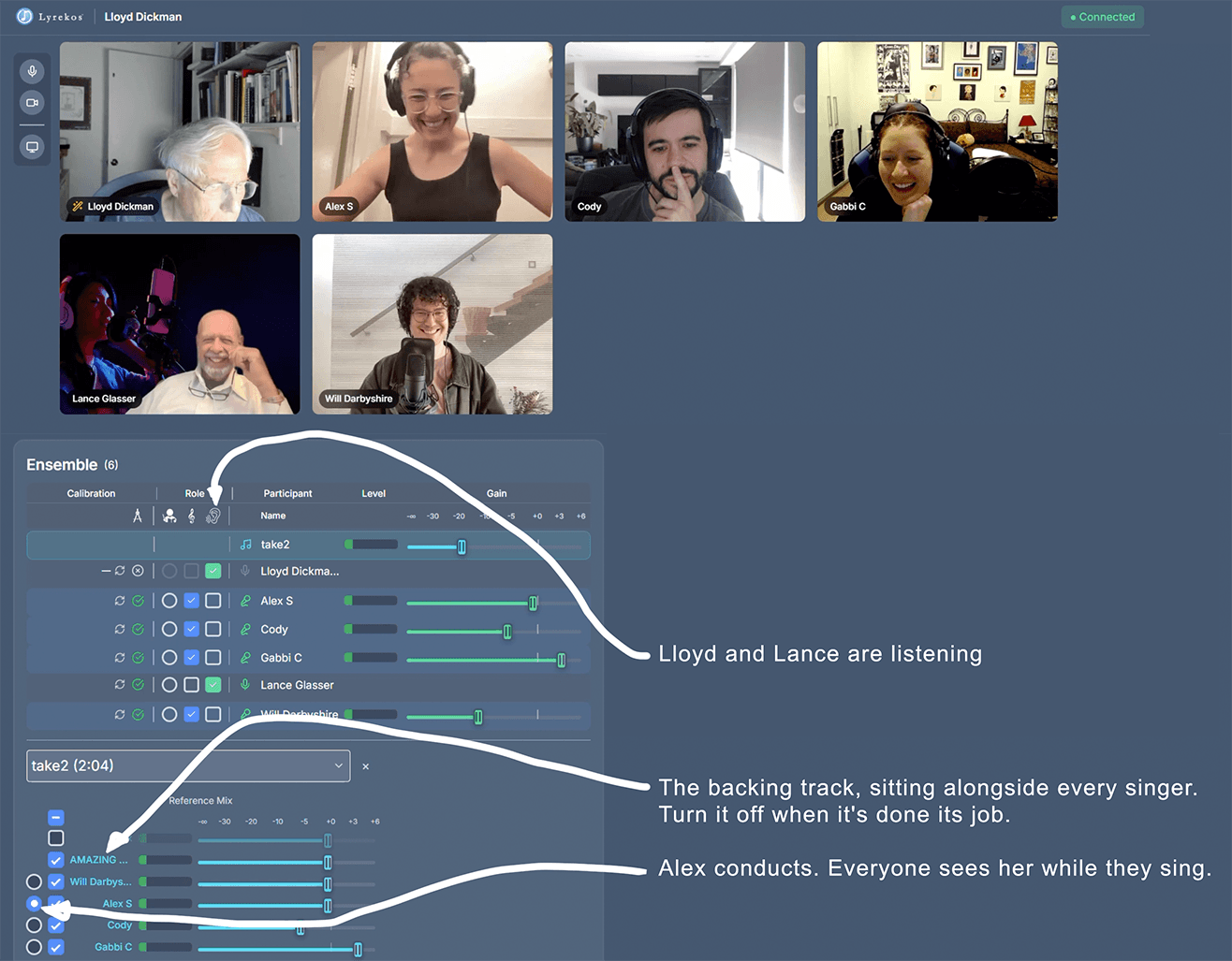
Instead of asking your singers to synchronize with each other, which is the part physics won’t allow, we give them all one shared reference to sing against. A piano track. A rehearsal recording. Your own voice. Every singer locks to that, not to their neighbor, and the distance between them stops being a variable in the problem.
A circle of singers listens to each other. Lyrekos gives you a reference circle instead. Same result, different geometry.
Then they hear each other
A reference track alone would just be twenty people singing into the void. So the second pass changes.
On the next take, each singer hears everyone else’s previous take, minus their own. Your second sopranos aren’t singing to a metronome anymore. They’re singing to your choir. Come in early and you’ll hear it. Sit under the tenors and you’ll hear that too.
Iterate as many times as the piece needs. And when it’s finished, optionally turn the piano off. The scaffolding comes down. The building stands.
Or you can be the reference yourself
Nothing above requires you to give up the podium.
Drop the backing track entirely and conduct. Your singers hear you and, just as importantly, watch your hands and read your lips. You become the reference, and you’re creating it in the moment. Same physics, different source.
There is a price, and it’s yours to pay. You hear only yourself. Sound cannot arrive before it departs, so if you waited to hear the group, they would be waiting to hear you, and the whole thing would spiral. Somebody has to break the loop. That somebody is the person in front.
Here are the same four singers with no rehearsal, no score, and nothing agreed in advance. Alex just conducts. We wrote up what that was like in Conducting a choir live, remotely.
Practice or performance
Use it Tuesday to drill the fugue nobody has clean yet. Use it in November when three of your singers are traveling and you still want them in the concert.
Same tool. The difference is what you do with what comes out.
What Lyrekos is not
It is not for jamming. If you want four musicians improvising off each other in real time, that’s a genuinely different problem and we don’t solve it. JackTrip and Jamulus do, and they’ll ask you for an ethernet cable and an audio interface in exchange.
Somebody or something has to lead. Every session needs a reference. It can be a professional recording, a piano part you tapped out on your phone, a previous take, or you standing in front conducting. What it can’t be is nothing. Four people agreeing to start on three does not work here, and it doesn’t really work in a room either.
It runs in a browser. Nothing to install, nothing to buy, no IT ticket. Every singer you send a link to opens it and is in. That matters more than it sounds like it does, because the tool that half your choir can’t get working is not a tool.
Questions we get
Do we need special equipment?
No. The headphones and microphone you already use for video calls are fine. Headphones or earbuds are better than speakers, since without them the backing track leaks into your microphone and can’t be fully removed later. For a rehearsal that’s rarely a problem. For a performance you plan to keep, it is.
How far apart can singers be?
We’ve run sessions between California and Australia. We’ve run over a satellite link. Distance doesn’t degrade the result.
What about copyright?
Rehearsing is one thing. Recording a performance and sharing it is another, and it raises licensing questions that don’t come up in a rehearsal room. We’ve written about what’s involved in Who Owns the Song You’re Singing?
Does it work on a phone?
Yes, on current iPhones and Android phones, in the browser. No app.
Read more
Eight thousand miles, one rehearsal — how the session in the video above actually ran.
Conducting a choir live, remotely — what changes about your gesture when the podium is a webcam.
Quick start guide — Lloyd walks through a first session end to end.
Tell us about your ensemble.
How many singers, how far apart, and what you’re trying to get done. We’ll tell you honestly whether this fits.
Only your name and email are required. Everything else is optional — skip anything you’d rather talk about later.