
Four people. No rehearsal. No score.
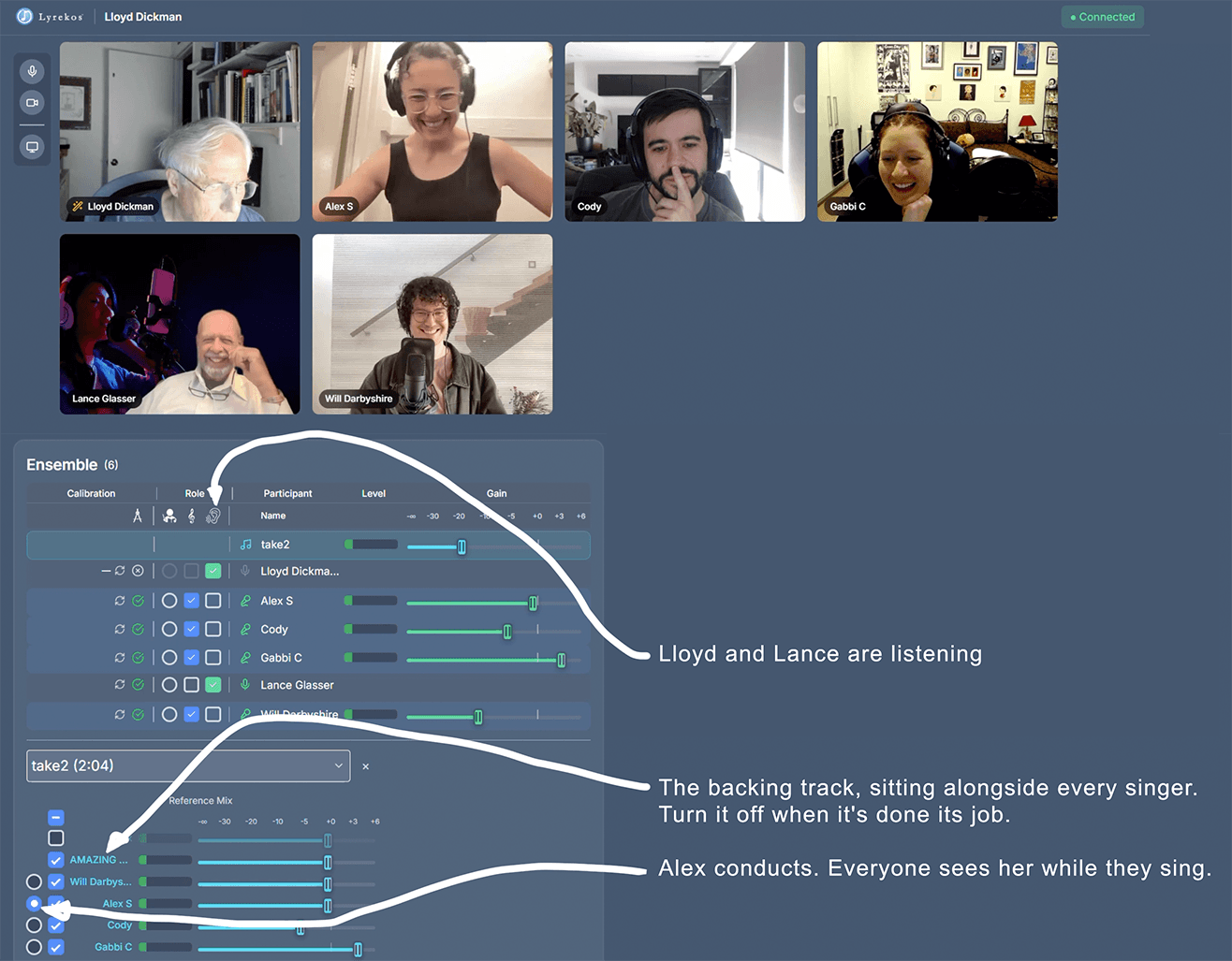
Nobody agreed in advance who would sing what. Alex counted them in and conducted, and they worked out the harmony as they went. Two of them were in Australia.
This is closer to what happens in a room full of people who all know the tune than any recording session is. Stay for the end, where they react to what they just did.
Why Zoom can’t do this
You have probably already tried. Everyone mutes, one person sings, and the rest of the congregation watches. Or nobody mutes and it collapses into noise.
That isn’t a bandwidth problem and better internet won’t fix it. Sound takes time to travel, signals take time to cross a network, and on a video call every person hears every other person late, by an amount that differs for each pair and drifts minute to minute. A group cannot stay together under those conditions. It isn’t a discipline problem. It’s physics.
What works today
Your worship team. The eight or twelve musicians and song leaders who carry the service. They can rehearse together during the week and lead together on the day, from wherever they are.
Everyone syncs to one shared reference rather than to each other, so the distance between them stops mattering. That reference can be a recorded track, a previous take, or a person out front leading live. On the next pass, each singer hears everyone else’s last take, so they’re singing with the group rather than into a void.
It runs in a browser. Nothing to install, no equipment to buy, no volunteer who can’t get it working. That last part matters more for a worship team than for a professional ensemble, because your team is mostly people who showed up.
Do you also have a choir? Plenty of congregations do, and a choir asks different things of this than a worship team does — sectionals, part-learning, and building a piece up over several takes. That’s all the same tool, and we’ve written it up for directors on the choir page.
What we’re building
The service itself. Congregation listening live while the team leads. We expect to handle around a hundred simultaneous connections, though we should say plainly that we’ve tested that with engineers rather than with a real congregation on home internet. That’s a design capacity, not a result.
Responsive prayer. Call and response is the shape of the liturgy, not a feature bolted onto it. Leader sings a line, congregation answers. It’s being engineered now and it isn’t finished.
Text on screen. Following along together, advanced by whoever is leading.
We are telling you what isn’t built because you’ll find out anyway, and because the congregations we work with in the next few months are going to shape what these become.
What Lyrekos is not
It is not for improvising together in real time. Different problem, and we don’t solve it.
Somebody or something has to lead. Every session needs a reference. A recording, a previous take, or a person conducting. What it can’t be is a group agreeing to start on three.
It does not replace being in the room. Nobody thinks it should. It’s for the weeks when people can’t be together.
Questions we get
Do people need to install anything?
No. It runs in a browser on a computer, tablet, or phone. Headphones or earbuds are needed for anyone singing, since open speakers feed back into the microphone. People who are only listening don’t need to do anything special.
How many people can join?
We expect around a hundred. That’s a design capacity rather than something we’ve confirmed with a real congregation, which is one of the things we’re hoping to learn with early partners.
What does it cost?
Nothing to talk to us, and nothing to try. Let’s find out whether it helps first.
Read more
Rehearsing a church choir or worship team online — preparing for rehearsal and having the rehearsal are two different problems.
Conducting a choir live, remotely — how the video above worked.
Singing together across 8,000 miles — the longer session, from California to Australia.
Quick start guide — a first session end to end.
One service. Once. With us on the line.
We’re looking for a small number of congregations willing to try this for a single service, with both founders standing by the whole time. You’d be helping us find out what a service needs that a rehearsal doesn’t.
We know this means a conversation with more than one person on your end. Music committees are how houses of worship work, and we’re happy to be on that call too.
Only your name and email are required. Everything else is optional — skip anything you’d rather talk about later.